TikTok Ads Examples: How Ecommerce Ad Creatives Use Product Storytelling to Drive Conversions

TikTok Ads Examples: How AI Ecommerce Ad Creatives Use Product Storytelling to Drive Conversions
In the TikTok ecommerce ecosystem, more brands are paying attention to the creative patterns behind high-performing ads. This July 29 AI commerce-video report analyzes several TikTok Ads Examples to show how viral ecommerce videos use scenarios, product storytelling, and customer needs to drive conversions.
Our key finding: high-performing ad creatives do not simply show a product. They help viewers picture how life could change after a purchase.
The clearest pattern in today’s ranking is that every product is placed inside a specific “outcome scene.”
A mini projector in Vietnam invites viewers to imagine a child opening a gift and a bedroom becoming an underwater world. Herbal tea and everyday products in Indonesia turn ideas such as a lighter-feeling morning, a hotel-like fragrance at home, or hands that no longer feel dry into tangible everyday outcomes.
For brands, the takeaway is practical: product display is not the end of the content. When people can see their post-purchase life first, the product has a better chance of entering that picture.
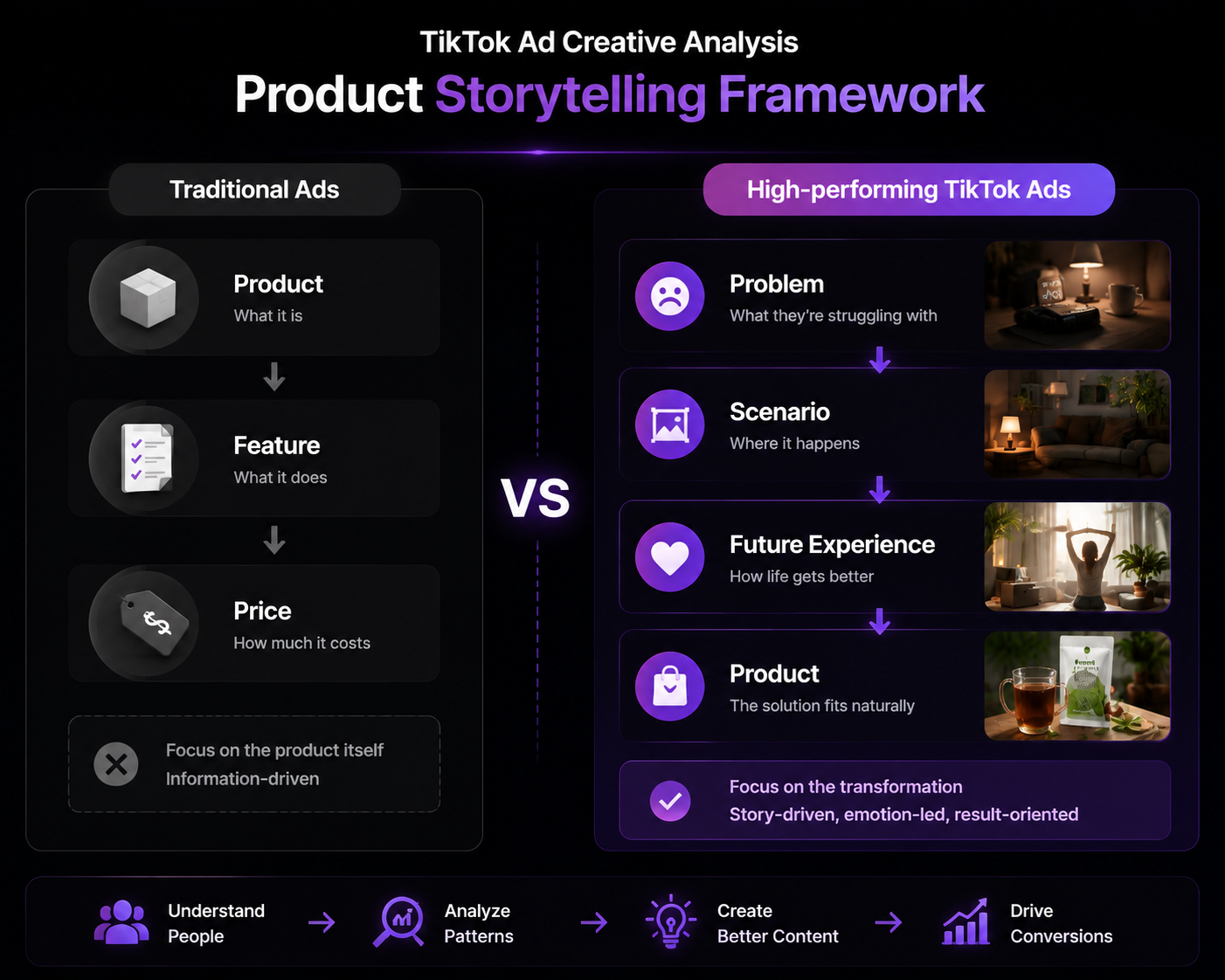
Three Confirmed Patterns in TikTok Ecommerce Ads
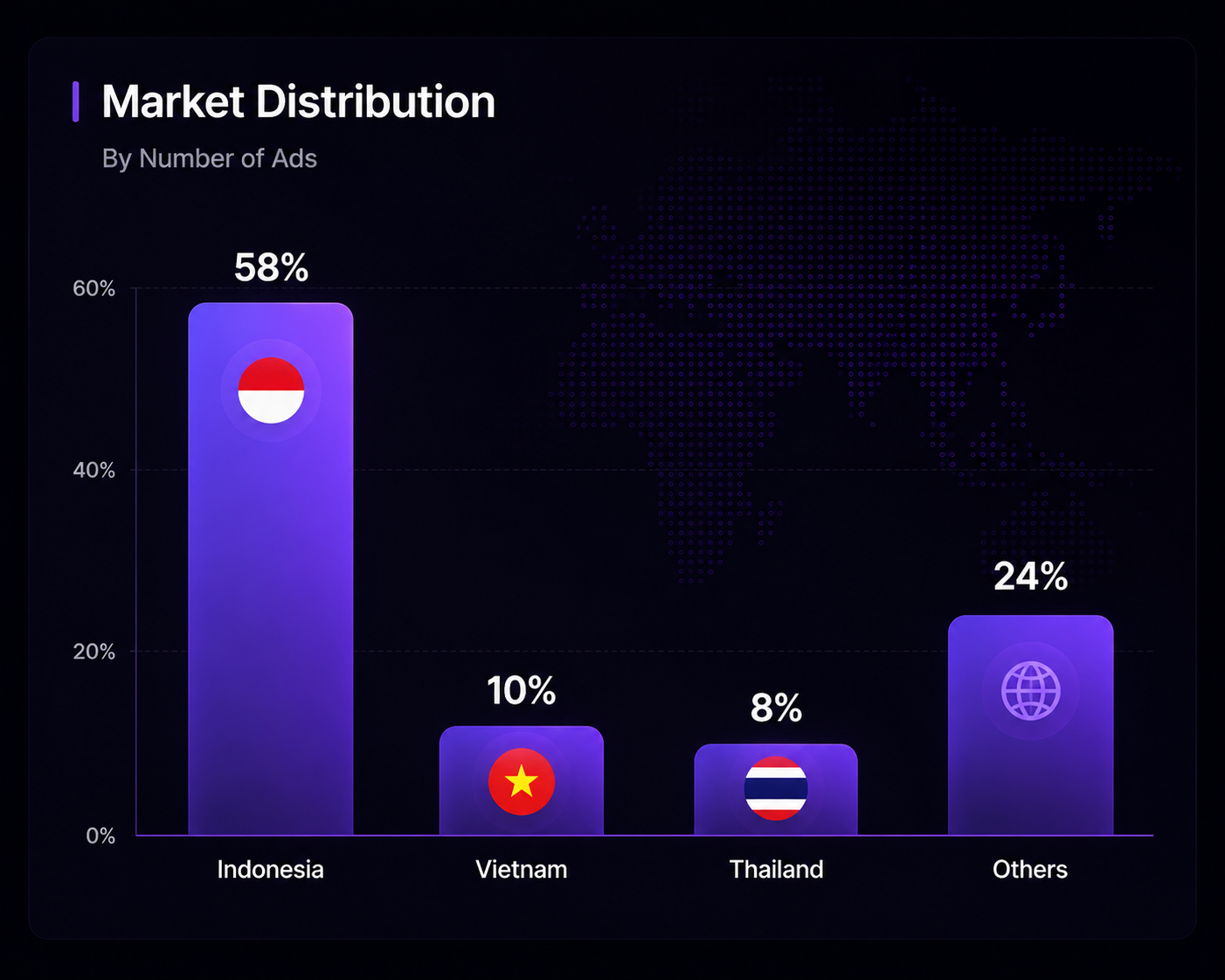
1. Everyday consumer goods are frequent examples in Southeast Asian TikTok ecommerce ads
Of the 50 ad creatives reviewed, 29 came from Indonesia, accounting for 58% of the sample and roughly 160 million total views.
Across these TikTok ecommerce ads, everyday consumer goods appeared most often in Indonesia: herbal tea, personal-care products, home fragrance, and food.
This does not mean one market is inherently better than another. Countries, categories, and media costs cannot be compared directly. But for brands looking for reusable ad ideas, Indonesian everyday-goods creatives offer a dense sample of content patterns.
2. Winning TikTok ads often validate a “product × scenario” combination
The ranking includes at least three mini-projector creatives from Vietnam, totaling roughly 31.2 million views and running 23–26 seconds. Their copy consistently places the product in a use or gifting scenario: “a gift for children,” “ocean projection,” or “mini projector.”
This is more meaningful than one isolated viral hit. It suggests that multiple creators are validating the same product-scenario combination. When several creatives cluster around one product, the market may be repeatedly testing a particular creative pattern.
3. Viral Product Videos focus on customer states, not product features
High-ROAS creatives in the sample included hand cream, herbal tea, lip balm, fragrance, and traditional foods. Their copy usually does not read like a product specification. Instead, it starts with a familiar customer state: dryness, fatigue, gifting needs, room scent, or a daily inconvenience.
Note that this is an observation about copy structure only. It does not verify any efficacy claims or imply that they apply in other markets.
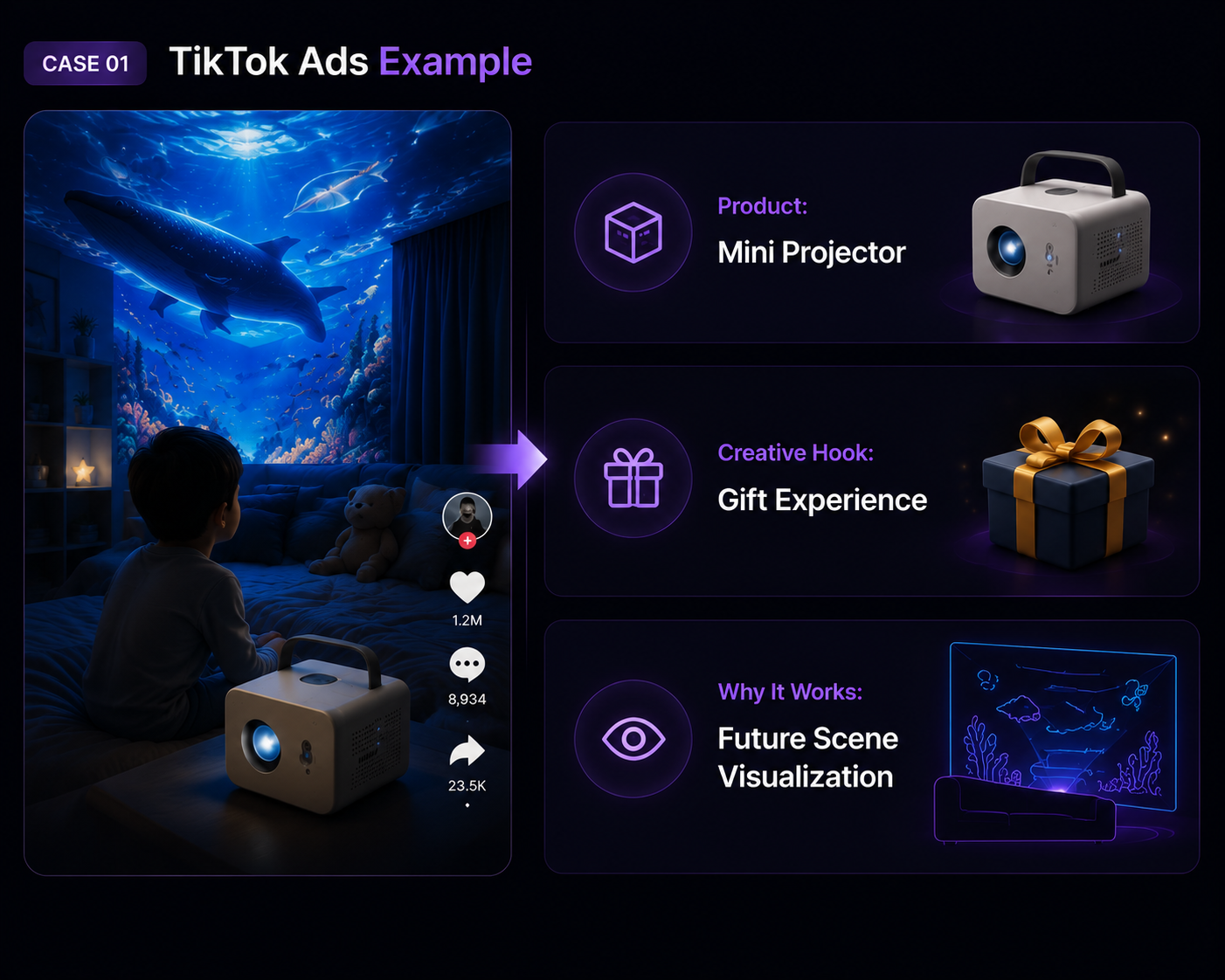
Case Study 01 | TikTok Ads Example: How a Mini Projector Creates a Reason to Buy Through Gifting
The core of this TikTok Ads Example is not a list of projector specifications. It uses a clear scenario to let shoppers imagine the experience after purchase.
Confirmed data
- Market: Vietnam
- Sample: 3 mini-projector creatives
- Total views: approximately 31.2 million
- Video length: 23, 24, and 26 seconds
- ROAS: 0.42, 2.39, and 2.45
One creative explicitly describes an “ocean projection gift for children.” The other two are framed around a “mini projector” or “projector for children.”
Octer’s view
Projectors are products that easily fall into feature-based competition.
In this TikTok ad, however, the creators do not lead with brightness or resolution. They use gifting, a child’s bedroom, and immersive viewing to create Product Storytelling.
The shopper may not be buying a device alone. They may be buying the experience that could follow the gift.
TikTok ad creative structure to test
Do not start with a feature list. Test a 20–25 second structure:
Gift recipient or an empty room
→ The environment changes after the projector turns on
→ The product appears as the source of that change
→ A clear gifting or use-case CTA
Source creatives
- Ocean projection gift | 18.8M views | ROAS 0.42
- Mini projector | 8M views | ROAS 2.39
- Mini projector for children | approx. 4.4M views | ROAS 2.45
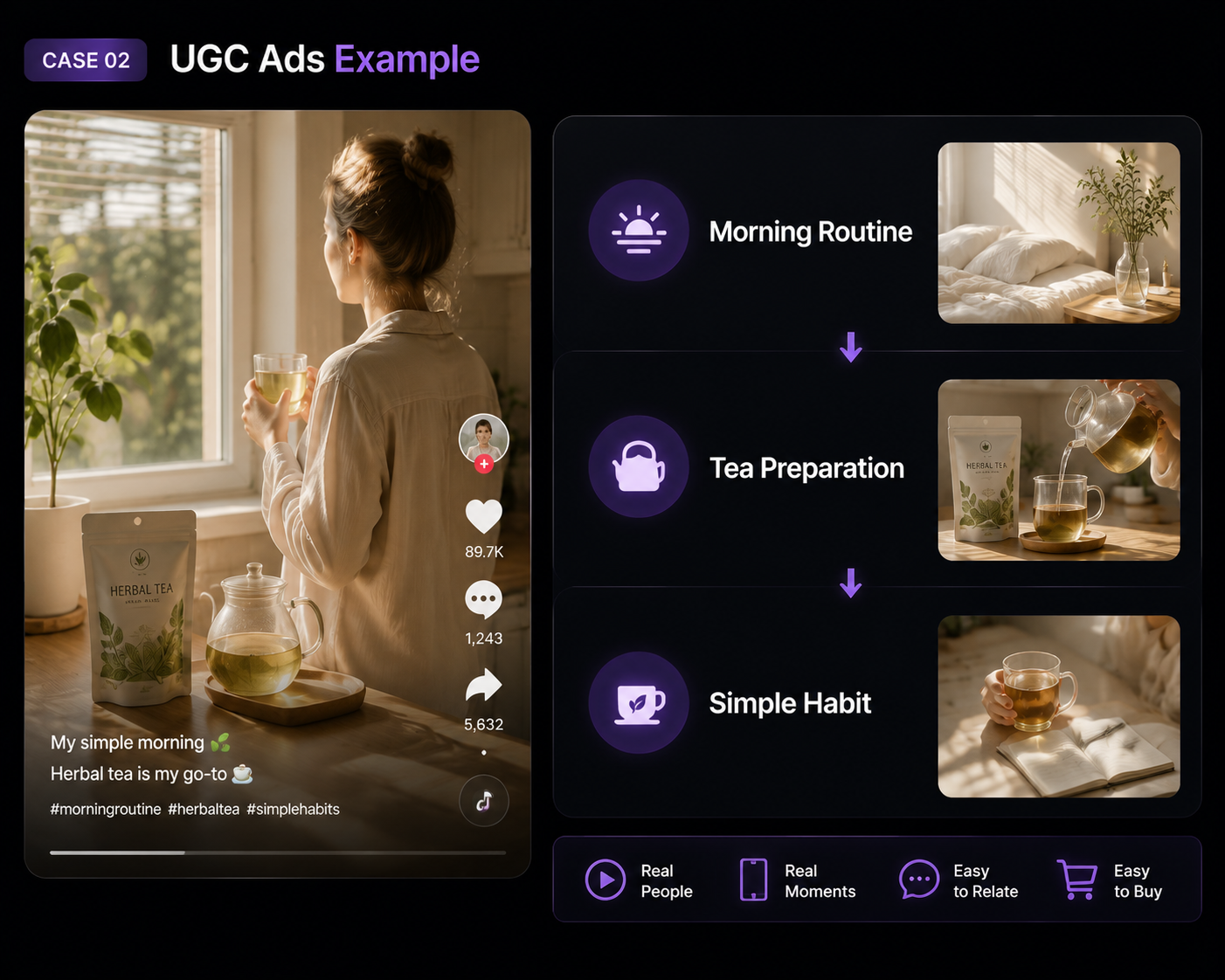
Case Study 02 | UGC Ads Example: How Herbal Tea Uses a Daily Scenario to Lower the Barrier to Purchase
This UGC Ads Example shows a common TikTok ecommerce ad structure: begin with a familiar everyday problem, then present a new habit that feels easier to adopt.
Confirmed data
- Market: Indonesia
- Sample: at least 4 creatives related to kumis kucing herbal tea
- Total views: approximately 48.6 million
- One creative: 35.9M views, 277.7K likes, 2,164 comments, ROAS 3.99
- Another creative: 6.4M views, ROAS 4.40
Their copy repeatedly opens with physical discomfort, the effort involved in preparing tea, or one’s state before starting the day, then lands on a convenient brewing format.
Octer’s view
The reusable lesson is not any health claim. It is a common communication structure in TikTok ecommerce ads:
problem scenario → friction to act → a simpler solution → the product becomes part of a daily habit.
Name an uncomfortable daily moment first; then show a low-friction new habit.
Compliance boundary
Health, wellness, and food brands should not replicate unsubstantiated disease-treatment or efficacy claims. The reusable structure is “pain point → a habit that is easier to sustain → the product reduces the effort required to act.” Any specific claim must be supported by the brand’s compliance documentation.
TikTok ad creative structure to test
A real, low-risk everyday frustration
→ Why the old approach is inconvenient
→ A new habit that is easier to follow
→ How the product removes friction from that step
Source creatives
- Herbal tea creative | 35.9M views | ROAS 3.99
- Herbal tea creative | 6.4M views | ROAS 4.40
- Herbal tea creative | 4.22M views | ROAS 0.03
- Herbal tea creative | 2.1M views | ROAS 0.50
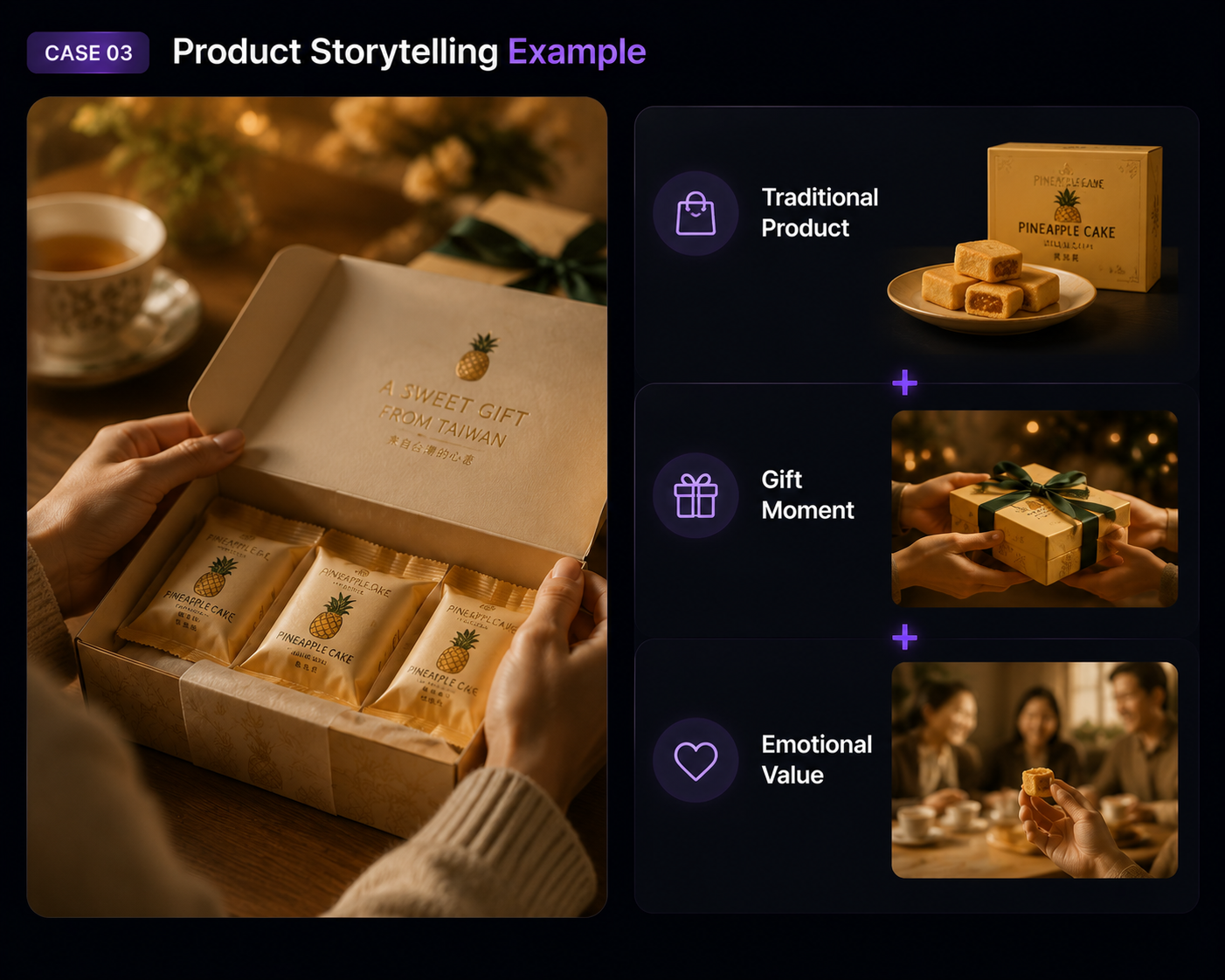
Case Study 03 | Product Storytelling Example: How Traditional Food Turns Packaging Into a Reason to Buy
In many ecommerce videos, packaging appears only in the final few seconds.
In this TikTok ad, packaging becomes part of the story itself. It conveys tradition, giftability, and a purchase occasion at the same time.
Confirmed data
- Market: Thailand
- Product: pineapple cakes / traditional home-baked food
- Length: 30 seconds
- Views: 4.2 million
- ROAS: 6.00 — the highest in this dataset
The creative copy highlights a “traditional family recipe,” taste, and an attractive tin box.
Octer’s view
This Product Storytelling Example shows that strong ecommerce videos do not merely explain what a product has. They answer a different question: “Why buy it now?”
For gift boxes, food, and regional specialties, giftability is itself a meaningful part of the value.
TikTok ad creative structure to test
The first moment of opening the gift box
→ One credible detail about tradition, origin, or craft
→ A specific moment of eating or gifting
→ A limited-edition, seasonal, or gifting CTA
Source creative
Octer Insight: Successful TikTok Ads Examples Show the Change People Want, Not Just the Product
Today’s ranking does not prove that AI-generated content is inherently more effective.
But these TikTok Ads Examples point to something more important: the core of a high-performing ecommerce video is not more elaborate production. It is a more accurate understanding of the change a customer hopes to see after buying.
Whether it is a child’s room changing after a gift, a morning habit that is easier to keep, or the sense of occasion when a gift box is opened, each creative performs the same job:
it turns a product into a concrete scene in the customer’s future life.
Before creating Viral Product Videos, brands and creators can first ask:
What is the one change a customer most wants to see immediately after buying this product?
Then decide how to design the shots, how to express the idea in UGC content, and where AI Video Marketing can improve efficiency.
FAQ: TikTok Ecommerce Ad Examples
1. What are TikTok Ads Examples?
TikTok Ads Examples are representative TikTok ad cases used to analyze ad creatives, video structures, product presentation, and conversion logic.
Strong examples usually do more than show product features. They use scenarios, emotion, and story to help viewers understand the value of life after purchase.
2. What makes a TikTok ad a Viral Product Video?
A high-performing Viral Product Video often includes:
- A clear problem scenario
- A fast reveal of the desired outcome
- A product that enters daily life naturally
- A simple, clear reason to buy
Compared with conventional ads, TikTok audiences tend to respond more easily to videos that feel like real experiences.
3. Why should brands analyze TikTok Ads Creative?
TikTok Ads Creative Analysis helps brands identify:
- Which opening approaches are more likely to capture attention
- Which product scenarios are more likely to create purchase interest
- Which content structures are worth testing repeatedly
4. How can AI help brands create ecommerce videos?
AI Video Marketing is not only about generating videos automatically. More importantly, it can help brands:
- Analyze large volumes of ad creatives
- Identify effective creative patterns
- Test different content directions quickly
- Reduce video-production costs
5. Why does Product Storytelling matter for ecommerce videos?
Product Storytelling is not about listing what a product is. It is about showing how that product enters a customer’s life.
For example, a projector can be described as having higher brightness, or as letting a child see an ocean world after opening a gift. The second version is more likely to create a reason to buy.