TikTok Ads Examples: Why Some Viral Product Ads Get Millions of Views but Low ROAS

TikTok Ads Examples: Why Some Viral Product Ads Get Millions of Views but Low ROAS
In TikTok ecommerce, short-form ads have become an important way for brands to earn attention and test product demand. As TikTok Shop grows, more brands are using TikTok Ads to test creative directions and learn which messages encourage viewers to take the next step.
TikTok's Creative Center surfaces creative trends, popular ad examples, and industry insights that help brands study the content formats gaining traction in different markets.
But one question remains central for ecommerce advertisers: does a high view count equal high commercial value?
Not necessarily.
A video can earn substantial reach because it is visually striking or entertaining. But if viewers do not go on to understand the product's value, that attention may not translate into purchases.
Brands therefore need to look at both traffic and conversion metrics.
ROAS, or Return on Ad Spend, measures the revenue generated from advertising spend and is a common metric for evaluating ecommerce advertising performance. Understanding and calculating ROAS
Put simply: views show how many people saw an ad; ROAS indicates whether that traffic generated commercial value.
The following TikTok Ads Examples examine why some high-view product ads did not produce equally strong returns.
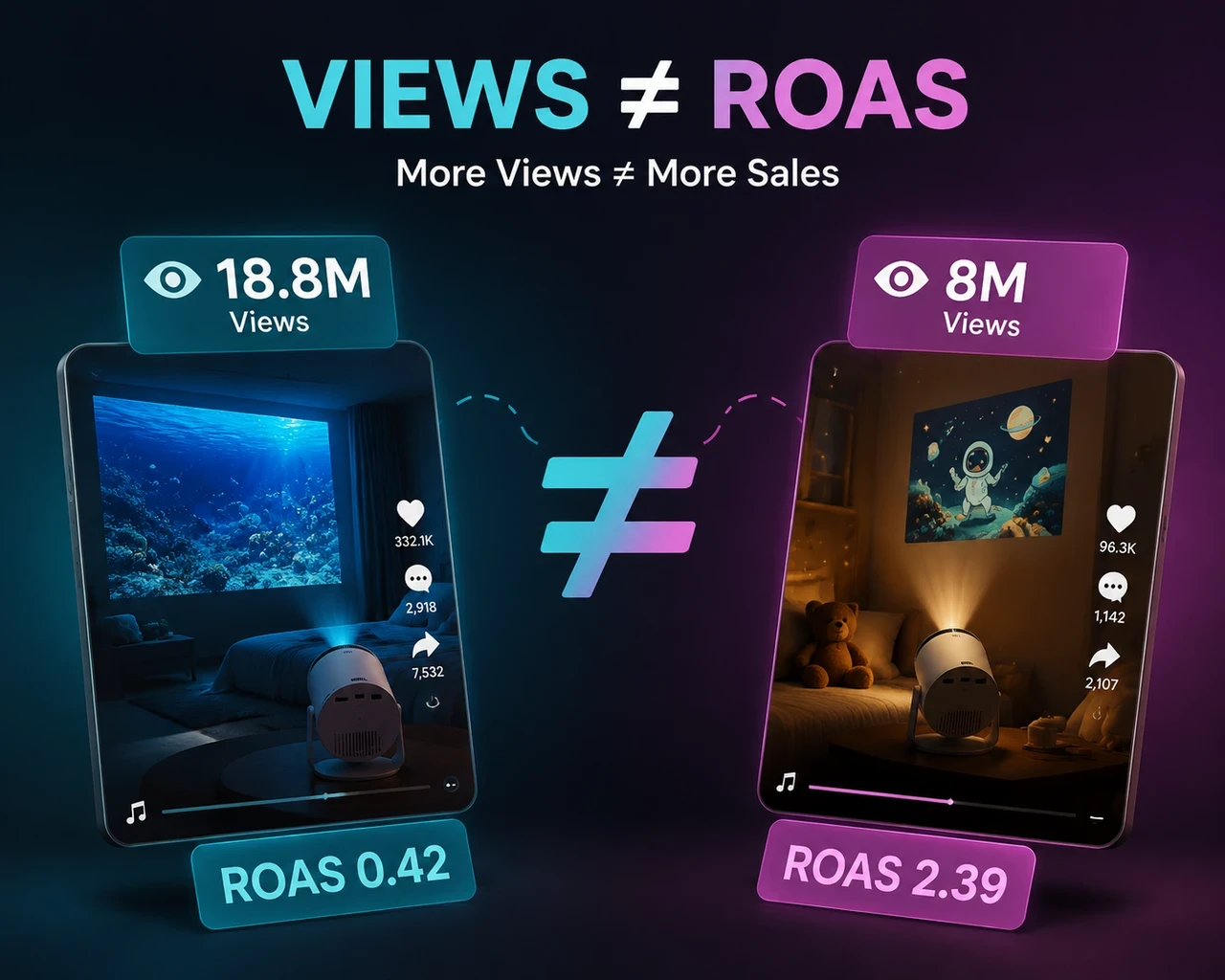
Case Study 1 | Mini Projector: 18.8M Views, but Why Was ROAS Only 0.42?
Confirmed data:
Market: Vietnam
Product: Mini Projector
Views: 18.8M
ROAS: 0.42
This TikTok ad is a clear example of high reach paired with limited conversion performance.
The creative successfully attracted a large audience. Yet its ROAS suggests that high viewing volume did not translate into a comparable level of purchase activity.
The video's strength is its visual hook. It shows an ordinary room turning into an underwater world when the projector is switched on. That immediate before-and-after transformation can capture attention quickly in a short-form feed.
However, the ad appears to do more to demonstrate the effect than to make the purchase case.
A viewer may think, “That projector effect looks interesting.”
But they may not immediately think, “I need to buy this product.”
For TikTok ecommerce ads, interest and purchase intent are not the same stage. A creative can earn views and engagement, yet still struggle to convert consistently if it does not help viewers understand the product value, relevant need, or reason to buy.
This case shows why TikTok Ads Creative Analysis cannot focus on views alone.
High views indicate that the content earned attention. ROAS indicates whether that attention produced commercial value. The metric does not isolate creative as the only variable: targeting, price, landing page, attribution settings, and other campaign factors can also affect ROAS.
The next TikTok product ad uses the same product category but records lower views and higher ROAS.
Case Study 2 | Mini Projector: Why Did 8M Views Produce a Higher ROAS?
Confirmed data:
Market: Vietnam
Product: Mini Projector
Views: 8M
ROAS: 2.39
Compared with the first TikTok Ads Example, this ad received fewer views but delivered a materially stronger commercial result. The comparison suggests that view count alone does not determine TikTok ad performance. The same product can perform very differently when it is framed through a different creative angle.
The key difference is that this creative does more than show the projection effect. It also gives viewers a possible reason to buy.
The first ad mainly communicates: “Look at what this projector can do.” This one more directly communicates: “This could be a gift for a child.”
That framing adds three useful pieces of context:
Buyer or recipient: a child
Use context: a child's room or family entertainment
Purchase motivation: gifting
Together, these details may make the jump from curiosity to a concrete need easier.
The viewer is no longer seeing only a functional product. They can picture a specific decision: “If I am choosing a gift for a child, this could be an option.”
This is a recurring pattern worth testing in TikTok Product Ads Examples: the product may stay the same, while the creative clarifies why a shopper might choose it.
When optimizing TikTok ad creative, brands can test not only different product demonstrations but also different purchase motivations:
Product feature demonstration → test whether viewers are interested
Gift context → test whether viewers see a purchase reason
Family entertainment context → test whether viewers can imagine using it
This example does not prove that the gift angle alone caused the higher ROAS. It does show a useful creative contrast: higher-ROAS ads do not always have the most views, and a clearer connection between product and purchase need is worth testing.
Case Study 3 | Herbal Tea: Why Can the Same Product Have Widely Different ROAS Across Creatives?
Confirmed data:
Market: Indonesia
Product: Herbal Tea
Creative A:
Views: 35.9M
Likes: 277.7K
Comments: 2,164
ROAS: 3.99
Creative B:
Views: 4.22M
ROAS: 0.03
The mini projector examples compare two creative angles for the same type of product. The herbal tea examples show another common pattern in TikTok ecommerce advertising: the same product can produce sharply different commercial results across different ad creatives.
Creative A combined high reach with a higher ROAS. Creative B still reached a meaningful audience but generated almost no effective return. This comparison suggests that advertising outcomes are shaped by both the product and how it is communicated.
The stronger creative does not simply explain what the herbal tea is. It appears to build around a familiar daily state:
Everyday concern → an attempt to change → a simple usage routine → the product becomes part of that routine
This structure may lower the effort required to understand how the product fits into a person's day.
Instead of only telling viewers, “This is a herbal tea product,” the creative focuses on a more relevant question: “Why might someone want this now?”
It also reflects one potential advantage of UGC-style ads. Compared with conventional brand advertising, UGC-style content can feel closer to an everyday user experience and less overtly promotional. That does not guarantee trust or conversion, but it can be a useful format to test.
For food and wellness-related products, brands should keep claims within what their compliance materials can support. The reusable lesson is the content structure—not any unverified health or treatment claim.
This case reinforces a key point from these TikTok Ads Examples: high-converting product ads are not only about showing more people the product. They can also make it easier for a viewer to understand how the product relates to their own situation.
When testing TikTok ad creatives, brands can compare whether viewers quickly understand the product value, whether the content reduces purchase hesitation, and whether the creative establishes a clear purchase reason.
Creative A
Creative B
Octer Insight: TikTok Ads Are Not Just About More Views—They Are About More Commercial Value
These three TikTok Ads Examples highlight an important distinction: high views do not necessarily mean high conversion, and high ROAS does not necessarily come from the highest traffic.
For the mini projector, the ad with 18.8M views achieved a ROAS of 0.42. Another creative with fewer views, but a clearer purchase context, reached a ROAS of 2.39. The herbal tea examples further show that the same product can produce very different outcomes when the creative changes.
That means brands evaluating TikTok Product Ads Examples should not look only at view count, likes, or whether a video became popular.
They also need to ask: why did viewers stop? Why might they believe the message? Why might they buy?
For TikTok ecommerce ads, traffic is only the first step.
Rather than simply trying to make more viral videos, brands can use ongoing creative testing to identify which angles attract the right audience, reduce hesitation, and give shoppers a clear reason to act.
The next stage of TikTok advertising competition is not only about winning more impressions. It is about understanding the customer's decision process more precisely.
A successful ad does not only help users see a product. It helps the right users think:
“This is relevant to me.”