Octer vs HeyGen: A Complete 2026 Comparison of AI Marketing Video Tools for Brands and Creators

Octer vs HeyGen: AI Video Tools Are Moving from “Generating Content” to “Creating Marketing Outcomes”
In the past, creating a single marketing video required a significant investment of time and resources. From creative conception and script design to filming, production, and post-production optimization, each stage demanded professional involvement. While this model ensured content quality, production costs and efficiency remained persistent challenges for brands and marketing teams that needed to continuously test content.
With the rise of short-video platforms, brands' demand for video content is rapidly increasing. According to the Content Marketing Institute's "B2B Content & Marketing Trends: Insights for 2026" study, which surveyed over 1,000 B2B marketers, the report indicates that companies are rethinking their content production methods and exploring how to leverage AI, data, and personalized strategies to improve marketing effectiveness. Video content and the ability to produce high-quality content are becoming crucial competitive factors for marketing teams. However, for today's marketing teams, the challenge is no longer just "making a video," but rather how to quickly generate more video material that resonates with different users, platforms, and marketing objectives.
With the development of the creator economy, brands are gradually shifting creator content from one-off promotional campaigns to long-term marketing strategies. According to the Interactive Advertising Bureau (IAB)’s “2025 Creator Economy Ad Spend & Strategy Report,” U.S. creator advertising spending is projected to reach $37 billion in 2025, a 26% year-over-year increase, with more and more brands viewing creator marketing as an important marketing channel rather than just a short-term collaboration.
For example, HeyGen focuses more on AI Avatar (digital human) and virtual presenter scenarios, enabling users to quickly generate video content that resembles real people appearing on screen.
October.ai, on the other hand, focuses more on the video production process in marketing scenarios, helping brands and creators generate advertising creatives, UGC videos, and product promotional content.
Put simply:
HeyGen solves: “How can AI express a message for you?”
Octer solves: “How can a brand keep producing marketing content?”
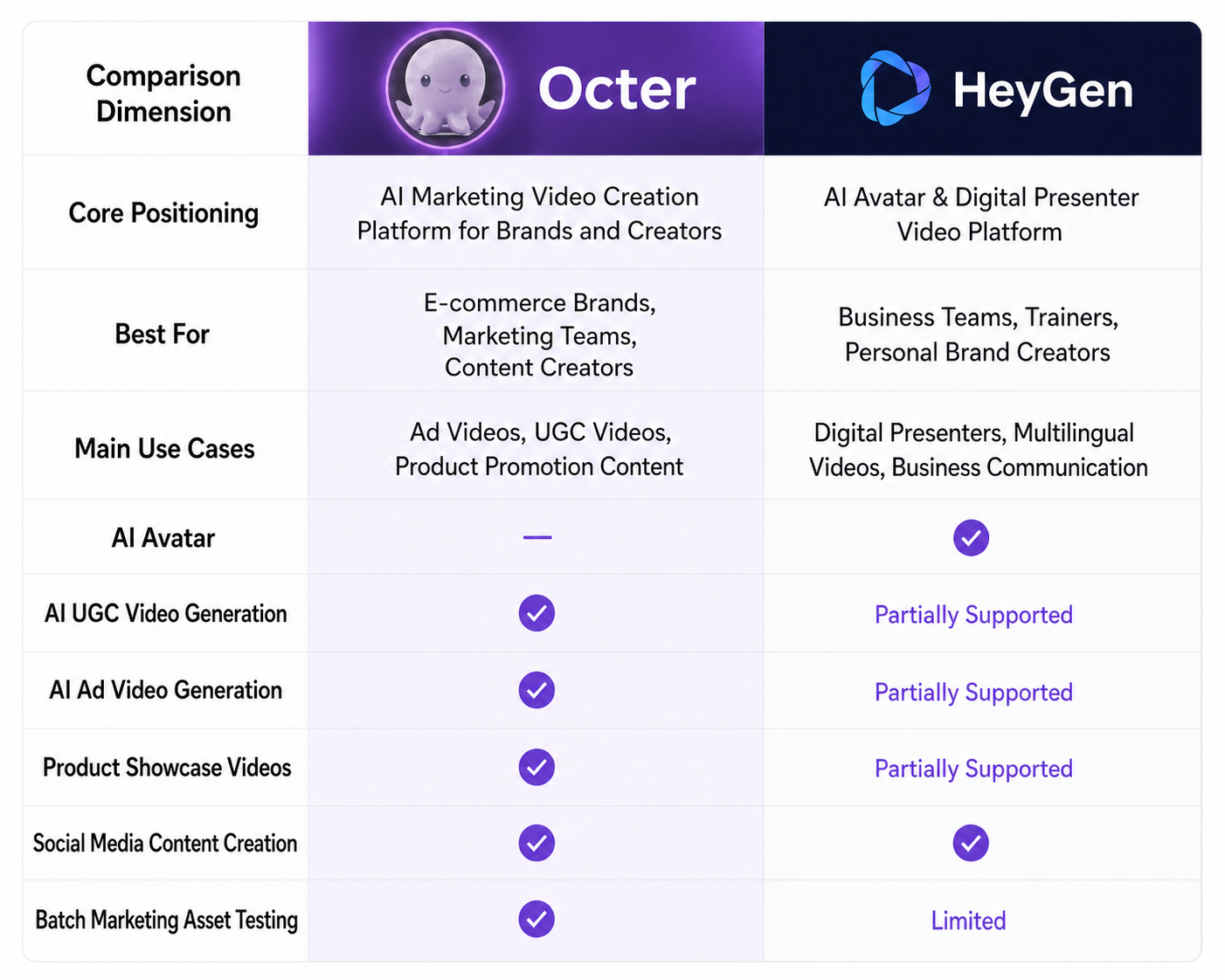
Octer vs HeyGen: Quick Comparison
When choosing an AI video tool, the most useful question is not which tool creates the “best” video in the abstract. It is which tool fits your content-production goal. Both HeyGen and Octer use AI to reduce production effort, but their primary use cases are meaningfully different: HeyGen is centered on AI avatars and presenter-led videos, while Octer is geared toward the ad, UGC, and product-content needs of marketing teams.
What Is HeyGen? An AI Avatar–Powered Video Creation Platform
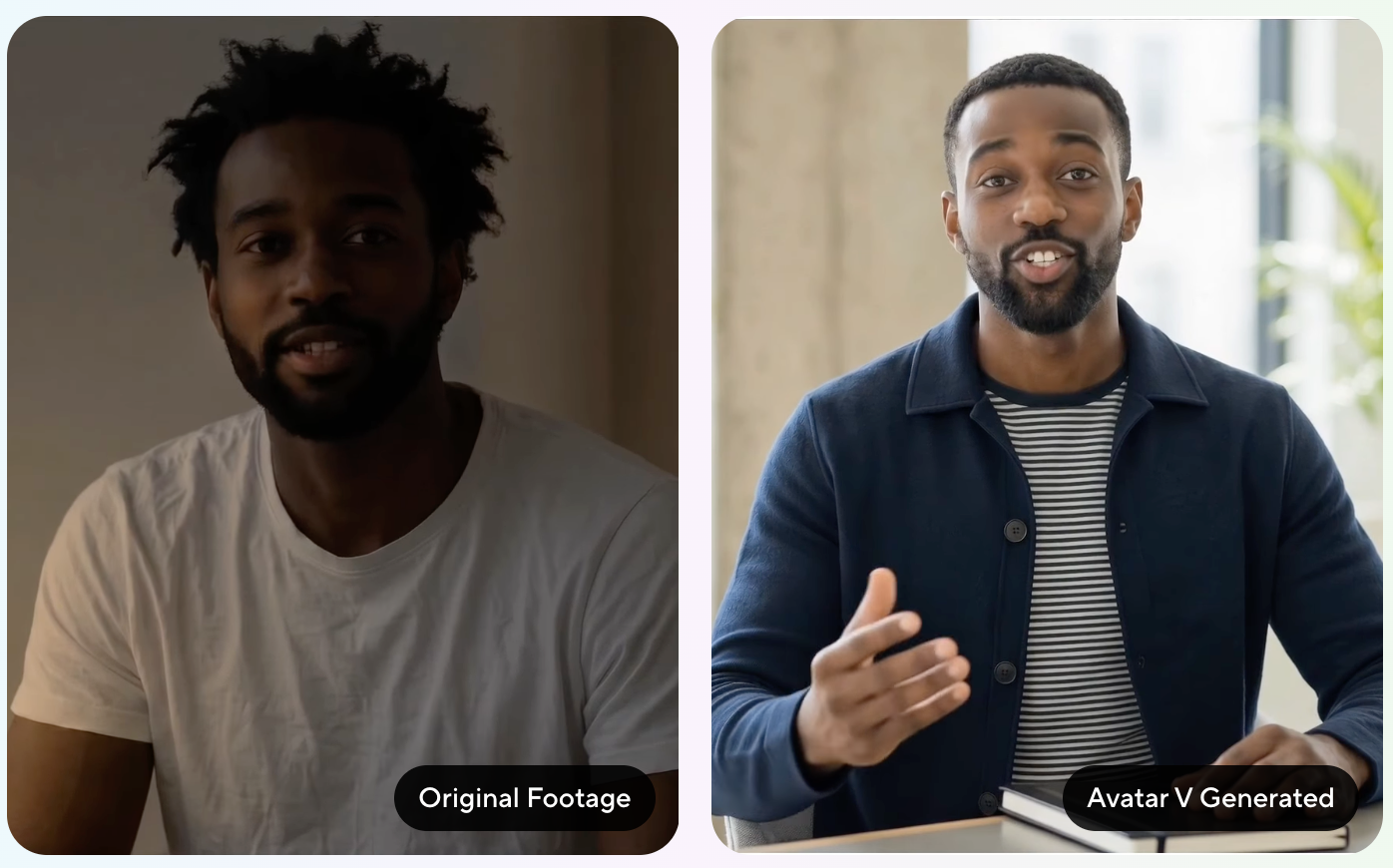
HeyGen is a representative tool in the AI video market. It uses AI avatars, voice generation, and video translation to help users create videos delivered by virtual people. According to HeyGen’s public product information, the platform offers avatar generation, voice cloning, video editing, and multilingual-video capabilities that can reduce the need for live filming and conventional video production for businesses, educational organizations, and creators.
Compared with traditional production, HeyGen’s central advantage is that it lowers the barrier to having a person appear on camera. Users can prepare a script and generate an avatar-led video with lip sync, voice delivery, and motion, without filming a live presenter.
| Use case | HeyGen’s advantage |
| Corporate training | Creates standardized content quickly with AI presenters |
| Product explainers | Uses a virtual presenter to introduce product information |
| Multilingual marketing video | Creates versions for different languages without re-recording |
| Online courses and education | Reduces lecturer recording requirements |
| Personal-brand content | Enables presenter-led video without being on camera |
HeyGen’s Core Strength: Making AI a Virtual Video Presenter
In conventional video, an on-screen person often serves an information-delivery role: introducing a product, explaining a concept, or presenting a service. HeyGen digitizes that role with AI avatars, allowing businesses and creators to make videos that resemble a person explaining something on camera.
For example, a company that needs product-introduction videos for several markets can create language versions with HeyGen without recording the same presentation repeatedly. This is why HeyGen is particularly useful for corporate communication, training, and international content production.
HeyGen’s Limitation: Video Marketing Is More Than Having Someone Speak
When a video shifts from information delivery to marketing growth, the requirements change. For advertising and social content, teams care not only about whether an AI presenter can explain a message, but also whether the content fits platform viewing habits, whether multiple creative directions can be tested quickly, whether different product angles can produce variations, and whether ad performance can be improved over time.
A strong AI avatar can help a brand communicate. Marketing teams, however, also need the ability to keep producing and iterating on content. This is the central difference between Octer and HeyGen.
What Is Octer? An AI Tool for Marketing Content Growth
Octer is an AI marketing tool for brands and creators. It helps teams generate, optimize, and iterate marketing content. Rather than focusing solely on a one-time video-generation task, Octer focuses on the complete path from creating marketing content to validating it.
For brands today, the challenge is not just making a video; it is continually finding effective content directions. Whether an ad creative works often depends on repeated testing of different structures, storytelling approaches, and audience perspectives. In conventional production, every adjustment creates additional production cost. Octer aims to reduce the cost of that experimentation and help brands improve their content strategy around market feedback.
Octer’s Core Capabilities: From Reusing High-Performing Content to Building Marketing Assets
1. High-Performing Content Analysis and AI Generation
In social-media marketing, brands frequently study content that has already performed well. Traditionally, teams must manually ask why a video worked: Was the opening compelling? Did it show the product differently? Did the speaker’s style better match platform behavior?
Octer can help users analyze high-performing content and generate new marketing assets from successful patterns. This is not simply copying a video. It means identifying useful content structures—such as pacing, storytelling, product-demonstration logic, and user-expression style—and adapting them to a brand’s own product.
Octer is not only about generating a video. It helps brands learn which kinds of content are more likely to work.
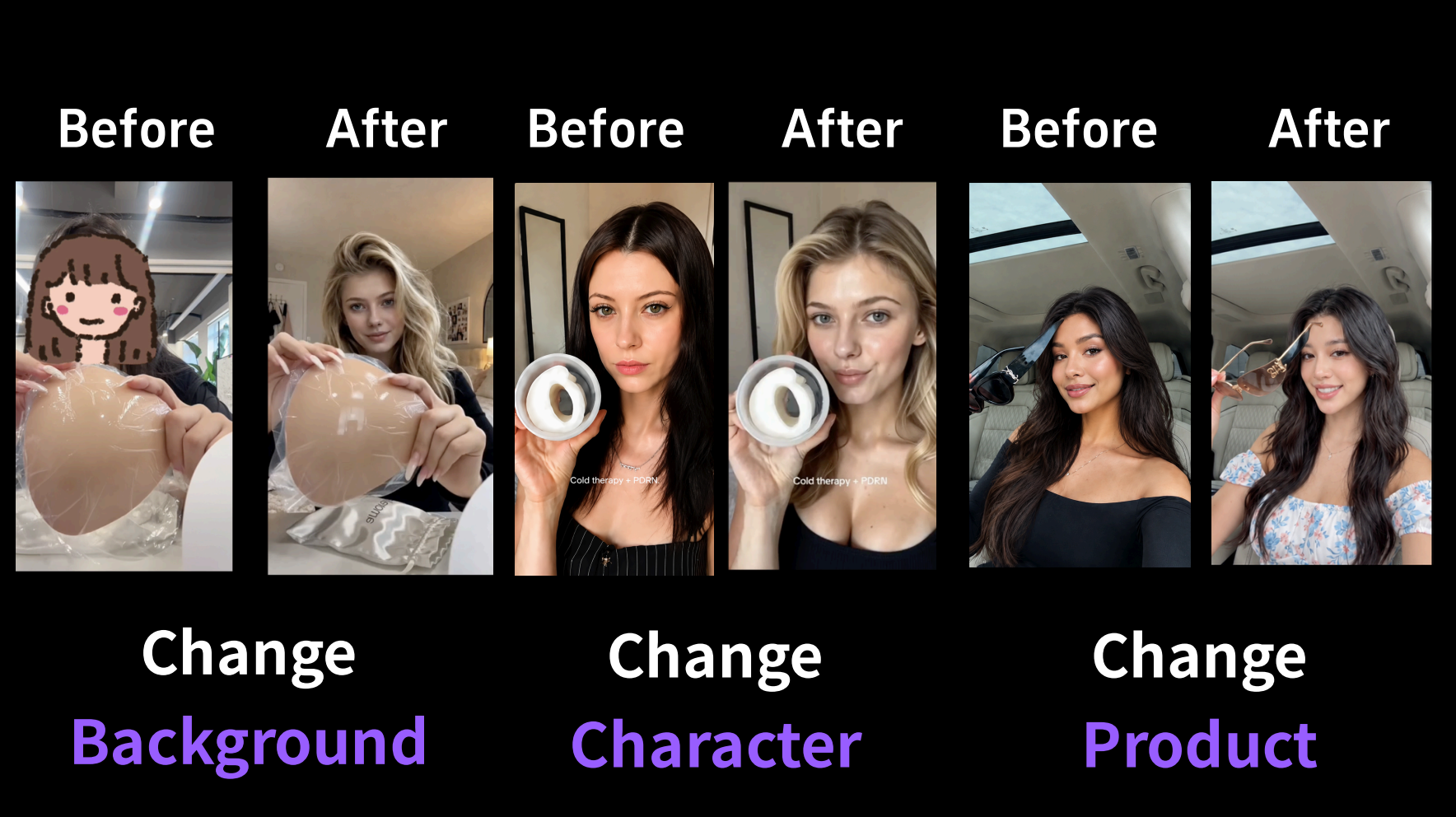
2. AI Face Swap and Fast Content Adaptation
A successful marketing-video format can often support multiple versions. A high-performing UGC-style video may derive its impact from a creator’s delivery, a particular shot structure, or a specific user scenario. With AI face-swap and content-adaptation capabilities, brands can explore different people, delivery styles, and product scenarios while keeping the creative direction consistent.
This helps brands test different creator styles, produce multiple ad variations quickly, and reduce the cost of reshooting. Compared with a traditional creator-collaboration model, AI can help teams explore more content combinations efficiently.
3. Building Brand Marketing Assets Through a Continuous Loop
A conventional marketing workflow can end after content is made, published, and measured. Octer is designed to support a continuous loop: discover high-performing patterns, generate assets, validate creative performance, retain brand marketing assets, and use those learnings in the next round of optimization.
As a brand uses this process, it can gradually accumulate marketing assets: effective video structures, high-performing creative directions, audience feedback, and product-messaging approaches. In this sense, Octer is not simply an AI video generator for marketing; it is intended to help a brand build an AI-supported marketing learning system.
Octer vs HeyGen: Which One Should You Choose for Different Use Cases?
Both Octer and HeyGen can lower video-production costs, but they serve different core needs. The right choice depends on whether your goal is to communicate a message through a presenter or to keep producing marketing content.
Choose HeyGen When You Need AI Avatar Videos
HeyGen is a stronger fit for virtual-presenter formats such as corporate training, product explanations, online courses, and multilingual business communication. The goal in these cases is clear information delivery: who will present, how natural the presentation should feel, and whether content can be made in multiple languages efficiently.
Choose Octer When You Need Marketing-Asset Production
Octer is a stronger fit for brands and marketing teams that need to keep testing content—such as TikTok ads, UGC-style videos, e-commerce product promotion, and social-media growth. Here, the question is not merely whether someone can introduce a product. It is which format will attract attention and drive conversion. Octer focuses on the path from high-performing-content analysis to asset generation, creative-version testing, and long-term marketing-asset accumulation.
Is Octer a HeyGen Alternative?
People searching for HeyGen competitors or a HeyGen alternative are usually looking for a solution that better matches their business scenario. The key is not which platform is universally “better,” but which tool fits a team’s content-production objective.
HeyGen has clear strengths in AI avatars and digital-presenter videos. It helps organizations and creators reduce the need for live presenters while producing communication-oriented video efficiently. For marketing teams, however, the goal is often not a single finished video. It is an ongoing process of discovering which content can attract an audience and convert.
That is where Octer offers a different possibility: a marketing-oriented workflow for generating and validating ad creative, UGC-style content, and product-promotion assets over time.
FAQ
What is the biggest difference between HeyGen and Octer?
HeyGen primarily solves AI-avatar and video-presentation needs. Octer focuses on marketing-content production, reusing high-performing creative patterns, and continuous optimization workflows.
Which AI video tool is better for making ads?
For brands that need to test large volumes of ad creative, produce UGC-style video, and promote products, Octer is designed more directly around marketing use cases.
How should I choose an AI UGC video generator?
Look beyond video quality. Consider whether the tool supports content iteration, creative testing, and the long-term accumulation of brand marketing assets.
Start building your AI-powered marketing content growth workflow.
Contact us to learn how Octer can help your team build AI-driven marketing workflows.
Contact the Octer team: https://octer.ai/