How to Find Micro Influencers for Product Seeding Campaigns

How to Find Micro Influencers for Product Seeding Campaigns
Most brands don't have an influencer problem,because they have a matching problem.
A creator with 500,000 followers looks impressive in a campaign report. But when the product reaches the wrong audience, those impressions rarely turn into customers.
Meanwhile, a micro influencer with 20,000 followers in a specific niche can generate stronger engagement, better feedback, and lower acquisition costs.
The shift is already happening. Brands are moving away from buying reach and toward finding creators who actually fit their products.
The problem is no longer whether micro influencers work.
It’s how to find the right ones.
1. Why Brands Choose Micro Influencer Marketing
Let’s get specific about what makes micro influencers different from bigger accounts. It’s not just about saving money, though the numbers on that front are hard to ignore.
1.1 The cost gap is real, but engagement density matters more
A macro-influencer charges $5,000 to $40,000 per post. A micro influencer typically charges $100 to $1,000, and plenty are open to product-first relationships.It means you can send them something good, let them try it, see what happens. Those headline numbers are easy to compare.
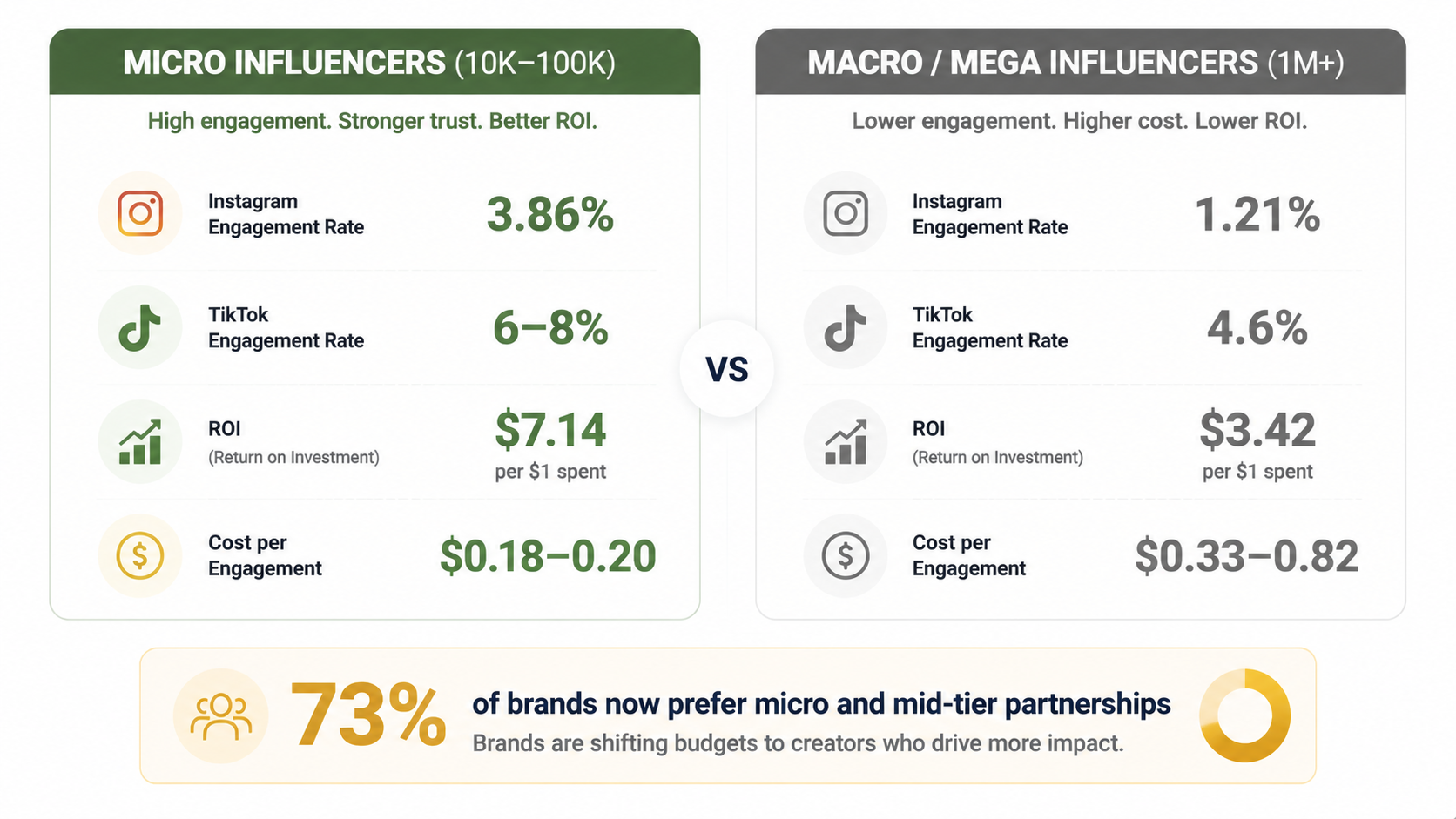
But there’s a less obvious number that matters more: cost per actual human interaction. Micro influencers average $0.18‒$0.20 per engagement; macro-influencers sit at $0.33‒$0.82. Run the same campaign budget through micro creators, and you walk away with 40‒60% more likes, comments, shares ― real signals, not just impressions. But most brands don't find this.
A creator with 20,000 followers in a narrow category like sensitive skincare, small-space organizing, trail-running gear.Those creators who have a sharper audience profile than a 500,000-follower lifestyle account. When you’re launching a product and trying to figure out who actually wants it, precision beats reach. Every time. The smaller account tells you something the larger one can’t: whether a real market exists here.
1.2 Trust shows up in the conversion numbers
Nano-influencers (1K‒10K followers) operate with 94.2% authentic audiences against 76.1% for mega-influencers. That’s not an abstract gap. Nano-influencers convert at 2.41%; mega- influencers convert at 0.91%. A 2.65x difference.
For a product launch, these dynamics stack into something practical: micro influencers let you test product-market fit and creator fit at lower risk, with more signal, before committing to campaigns that cost real money. Macro-influencers have their place in brand awareness at scale, mostly.But using them to figure out whether anyone wants your product is useless.
2. How to Find Micro Influencers for Your Brand
Search “how to find micro influencers” and you’ll get dozens of articles saying the same thing: check hashtags, look at your followers, scroll through TikTok. That manual approach works as a starting point. When you need to compare creators across audience demographics, content history, and contact availability at the scale of an actual campaign,it will be inffective.
2.1 Start with someone who already knows your product
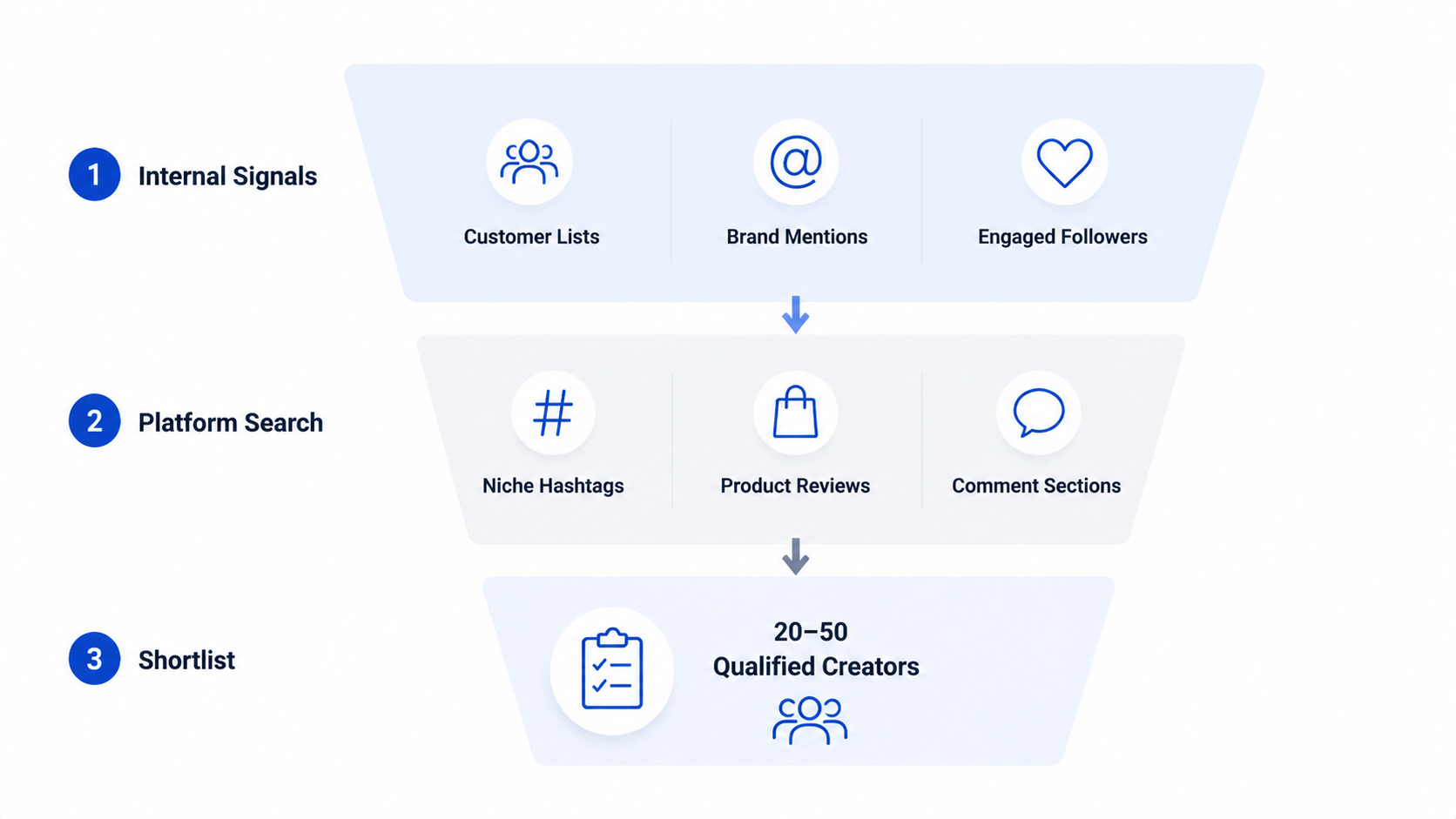
Before you go hunting externally, look at what you already have. Someone who have bought from you can be a stronger creator partner than a cold discovery.Check your customer lists and repeat buyers. Look at brand mentions and tagged posts and even the creators who’ve mentioned your product, even casually, are warm leads. Review comments and saves on your own content. Engaged followers who create content themselves deserve a closer look.
2.2 The limits of manual discovery
Manual search helps you to know the language of a category but it does not scale. After three hours of scrolling you’ll have a scattered list of usernames, no consistent format for comparing them, and probably no contact information beyond an Instagram DM link.
This is the point where a micro influencer platform or creator discovery tool stops being a luxury. At minimum, you want to filter by country, language, and platform, content category and niche, audience demographics and engagement signals, and past brand collaborations. A creator database turns discovery from a scrolling session into something you can repeat across campaigns and markets.
2.3 Build a shortlist, not a spreadsheet of 500 names
For a first product seeding campaign, start with the number of creators you can genuinely qualify, personalize outreach for, and fulfill. For each creator on the shortlist, document their profile link and preferred contact channel, content niche with a representative post, audience geography and demographic fit, why the product fits their style, recent competitor or category partnerships, a suggested angle for collaboration, and current status with next action. This does two things: it makes your current campaign manageable, and it builds an asset you can reference for the next launch.
3. How to Find Japanese and Korean Micro Influencers
The core process (brief, discover, qualify, outreach, fulfill, evaluate)stays the same regardless of market. But the discovery layer and outreach norms differ enough between Japan, Korea, and Western markets that a translated version of an English-language campaign will underperform in both. Guaranteed.
3.1 Market snapshot: Japan vs Korea at a glance
| Japan | South Korea | |
| Influencer market (2025) | ¥86 billion (~$570M) | $500M–$800M |
| Micro-influencer engagement | 3–5% | Naver Blog 13% less engagement on sponsored vs organic (vs 50% drop on Instagram) |
| Micro post cost (typical) | ¥50,000–¥200,000 | ₩500K–₩3M; Naver Blog $50–$500 |
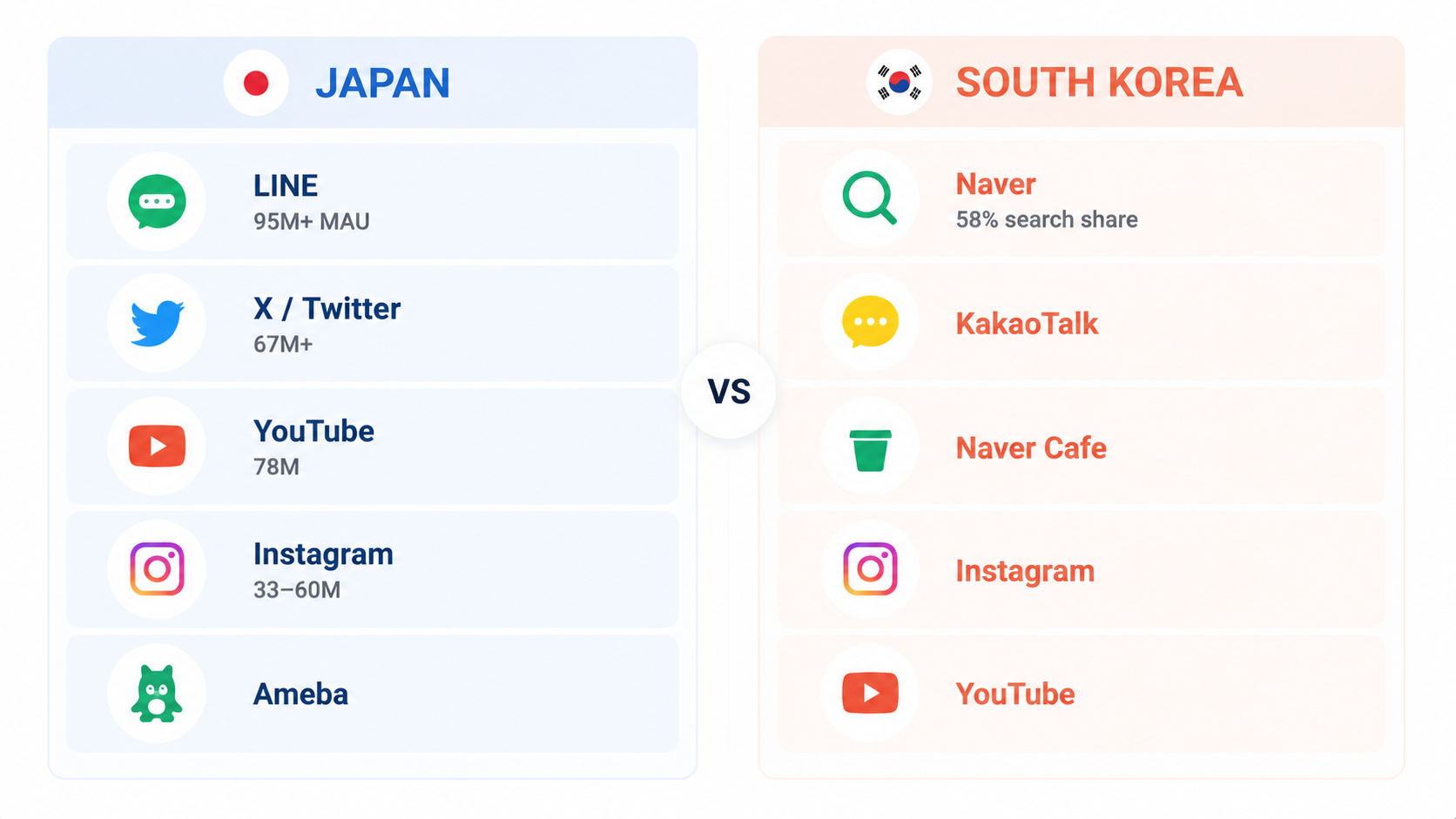
| Dominant local platforms | LINE (95M+ MAU), X (67M+), Ameba | Naver (58% search share), KakaoTalk, Naver Cafe |
| Campaign style | 72% performance-driven | High commercial expectation from first contact |
| Influencer culture | Niche-trust model; community depth over reach | Professionalized; media kits are standard even for micro creators |
3.2 Finding micro influencers in Japan
The Japanese creator landscape runs on platform habits and trust dynamics that look quite different from the US or Europe.
Niche depth functions as a genuine competitive advantage in Japan. Creators often build audiences within tightly defined interest communities like a specific makeup category, a regional outdoor brand scene, a particular game or anime subgenre. Broad English-language search terms will miss these clusters entirely. Search in Japanese, using the words consumers actually use within each niche. For brands without in-house Japanese capability, a creator database with local-language filters becomes essential rather than nice-to-have.
Collaboration tone matters as much as the offer itself. Cold outreach from an unknown international brand gets a lower response rate than in Western markets. Many Japanese micro creators prefer a clear, polite explanation of the product and the brand’s intent. Ambiguous offers or pressure to post will reduce response rates. A formal but warm tone signals that you’ve done your homework and respect the norms.
3.3 Finding micro influencers in Korea
The Korean creator ecosystem moves fast. It’s highly commercialized and concentrated around a few dominant platforms.
Korea’s beauty and lifestyle creator market is probably the most developed in the world. Even micro creators often have professional media kits, defined rates, and experience with multiple brand partnerships. Expect a more commercial dynamic from the first interaction than in Japan.
Micro influencers (10K‒100K followers) typically charge ₩500,000‒₩3,000,000 per post depending on platform and category. This professionalism cuts both ways: negotiations are faster and clearer, but expectations around compensation and creative control run higher.
Trend cycles move faster in Korea than almost anywhere else. A creator who was highly relevant six months ago may have shifted categories or audience composition. The influencer marketing platform market in Korea is projected to grow at 22.8% CAGR to nearly $1 billion by 2031 that new creators enter constantly, audience attention shifts fast. Freshness of data matters more here. Check recent posting frequency and engagement before adding anyone to a shortlist.
3.4 Why a regional creator database matters
For both markets, manual search in a language you don’t speak is slow and error-prone. The platform mix alone LINE, X, Instagram, YouTube, Ameba in Japan; Naver Blog, Naver Cafe, KakaoTalk, Instagram, YouTube in Korea which means a single-market discovery workflow misses the channels where real influence lives.
A creator database with local-language data (profiles, audience demographics, contact preferences, past collaboration history, platform-specific metrics) turns cross-border discovery from a guessing game into something repeatable. It also helps you avoid the most common mistake in international influencer marketing: sending the same pitch to creators in two fundamentally different markets.
4. How Octer Helps Brands Discover and Manage Micro Influencers
Octer was built to handle the repetitive parts of that workflow.
A searchable creator database instead of a scrolling session. Octer’s database covers creators across Instagram, TikTok, YouTube. You filter by country, category, audience demographics, engagement benchmarks, and past brand collaborations. Three hours of manual scrolling becomes a filtered shortlist in minutes.
Personalized outreach without the copy-paste fatigue. Octer generates draft outreach messages tailored to each creator’s content style, niche, and past collaborations. You’re not sending fifty versions of the same template. Each message references the creator’s actual content and positions the product as a natural fit for what they already make. You review and adjust before sending, then the tool handles the first draft, you handle the judgment.
Inbox that knows who replied and what to say next. Octer tracks outreach status across your entire shortlist: sent, opened, replied, needs follow-up. When a creator responds, Octer surfaces a suggested reply based on the conversation context whether they’re asking about the product, confirming interest, or politely declining. No more spreadsheet tabs with color-coded cells and forgotten threads from last week.
Find your creators in Octer.
FAQ
How do I find micro influencers on Instagram or TikTok?
Start with what you already have: your own customer list, people who’ve tagged your brand, people who’ve mentioned your category. Then search the way your customers search ― niche hashtags (#sensitiveskincareroutine, not #skincare), product reviews, comment sections on relevant posts. Manual search hits a wall fast when you need to compare dozens of accounts side by side. That’s when a creator discovery tool or micro influencer platform stops being optional.
What is a good engagement rate for micro influencers?
Instagram micro influencers (10K‒100K followers) average around 3.86% engagement. TikTok micro creators average 6‒8%. Above those numbers is good. But context matters more than the number itself ,a 2.5% rate in a low-engagement category can be stronger than 4% in a high- engagement one.
How do I find micro influencers in Japan or Korea?
Local-language search is non-negotiable. Japan: X, Instagram, YouTube, plus LINE for relationship management. Korea: Instagram, YouTube, Naver Blog, Naver Cafe, plus KakaoTalk for retention. The platform mix is different enough from Western markets that a translated campaign will miss the mark. A regional creator database with local-language data saves months of trial and error.
What is the ROI of micro influencer marketing?
Micro influencers average about $7.14 per dollar spent, against $3.42 for mega-influencers.
Product seeding specifically averages $7.25 per dollar; beauty and skincare campaigns can reach $11.40. These numbers are directionally useful, but your own results depend almost entirely on how well you match the right creators to the right product. The selection process matters more than the campaign model.
Data sources
· Engagement rate by tier (Instagram 3.86% / TikTok 6‒8%): Archive: 23 Micro-Influencer
Engagement Rate Statistics (2026) and Archive: Good Influencer Engagement Rate by Tier (2026)
· ROI comparison ($7.14 micro vs $3.42 mega): Keepface: Micro vs Macro Influencer Strategy
2026 ― Data, Costs and ROI Compared
· 73% of brands prefer micro / mid-tier partnerships; 33% YoY growth in micro-influencer
adoption: eMarketer: Smaller creators deliver efficiency as ROI pressure mounts and Archive: 14 Influencer Marketing Growth Statistics for 2026
· Authentic audience share (nano 94.2% vs mega 76.1%); conversion rate (nano 2.41% vs
mega 0.91%): Manychat: Micro Influencers Are Bagging Brand Deals and Building Community and Archive engagement benchmarks (above).
· Influencer gifting ROI ($7.25 avg / $11.40 beauty); post rate benchmarks (20‒40%
structured, 50%+ existing customers): GRIN: Influencer Gifting ― The ROI Case for Sending Product Before Asking for Content
· $32.55 billion global influencer marketing market (2025): Statista / Goldman Sachs, cited
via multiple 2025‒2026 industry roundups including Aspire: 4 Influencer Marketing Strategies That Actually Deliver in 2026
· 94% of marketers use product seeding; 61% report under half of gifted influencers post:
Socially Powerful and Traackr, cited via Advertising Week: Influencer Gifting Is Mainstream
· Shopify micro-influencer guide: Shopify: How to Find and Work with Micro Influencers
· FTC disclosure requirements: FTC: Disclosures 101 for Social Media Influencers